The Early Rock Daze
1987-1992 / Released 2008 / 2026 Remaster
Five Years of Rock, Raw Truth, and the Sound of Everything Beginning
The Legacy of All Legacy Albums
Before Explorations. Before Re-Sounding. Before Hodgepodge Jazz Garage. There was this - a raw, energetic collection of the earliest rock and jazz recordings Brian Grace ever committed to tape. Spanning five formative years from 1987 to 1992, The Early Rock Daze is not a polished retrospective. It is an honest document: the moment a young musician first sat down and started writing, arranging, and producing music with whatever tools he had within reach.
These 19 tracks range from fully produced Army Post studio sessions to Tascam 4-track demos stuffed to the gills with ideas. Are there cringe-worthy moments? Sure - and they belong here, because they are honest. The best work stands tall. The experiments that pushed beyond what the gear could handle still communicate everything that mattered: ambition, instinct, and an artist figuring out exactly who he was. All of it has been remastered to bring out the best of what those recordings had to offer.
"This is the true beginning of my musical story. The legacy of all legacy albums."
- Brian Grace
The Fort Dix Chapter
Fresh out of high school, Brian Grace shipped out to Fort Dix, New Jersey as a member of the United States Army Band - his first posting, and the unlikely birthplace of the Early Rock Daze recordings. From 1987 to 1989, those songs took shape in and around the Army Post, which was home to something most musicians would not expect to find on a military installation: a real, legitimate recording studio.
Tracks 1 through 8 (with one exception) were recorded there - capturing a young Brian Grace in full creative sprint, writing songs, layering guitars, playing bass, stacking vocals, and collaborating with Army Band pal and drummer Randy Servello.
The final recording made at the Fort Dix Army Post studio - and the album opener. Unite! is a statement of pure optimism: hopeful, progressive, and rocking hard from the first bar. Brian played every instrument and vocal part himself, with Randy Servello returning one last time on drums for what Brian calls "one final hoorah." Mixed time signatures run through the middle section alongside what he describes as a "creative grab bag" - sounds and ideas thrown together with total confidence and zero apology.
The song has two verses that tell a complete arc. The first opens with a direct plea: "People of the world unite, aren't you gettin' tired of this fight..." Then comes the long proggy middle - the musical argument. And then the second verse lands with the conclusion Brian had apparently already decided: "Now that you are all United, I guess that you are invited - to come here and see just what it's doin' to me - I feel my brain is so enlightened."
The logic, as Brian puts it: if you're not United, listen to my music - and after that, you'll all be enlightened. The optimism of a 21-year-old Army musician on the verge of everything changing, with Berklee College of Music waiting in January 1990 and a one-way trip back to Maryland to pack his bags. And then, just like that - poof. His 1980s were over.
"Hey, a guy can only hope..."
- Brian Grace, 1989. Fort Dix, NJ.
📷 The Fort Dix Recording Studio - August 1989
The final recording session at Fort Dix - tracking overdubs for "Unite!" - the last song ever recorded at the Army Post studio.

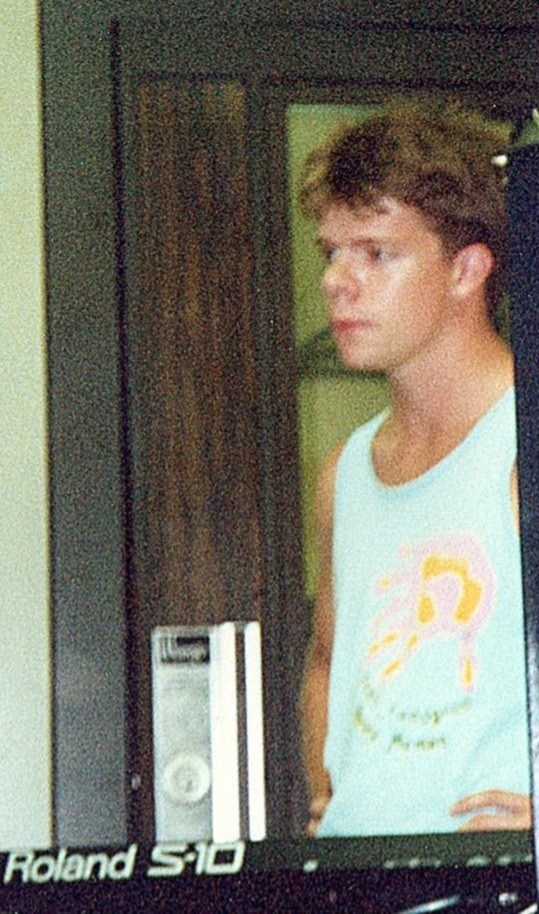
The last session at the Fort Dix recording studio - August 1989

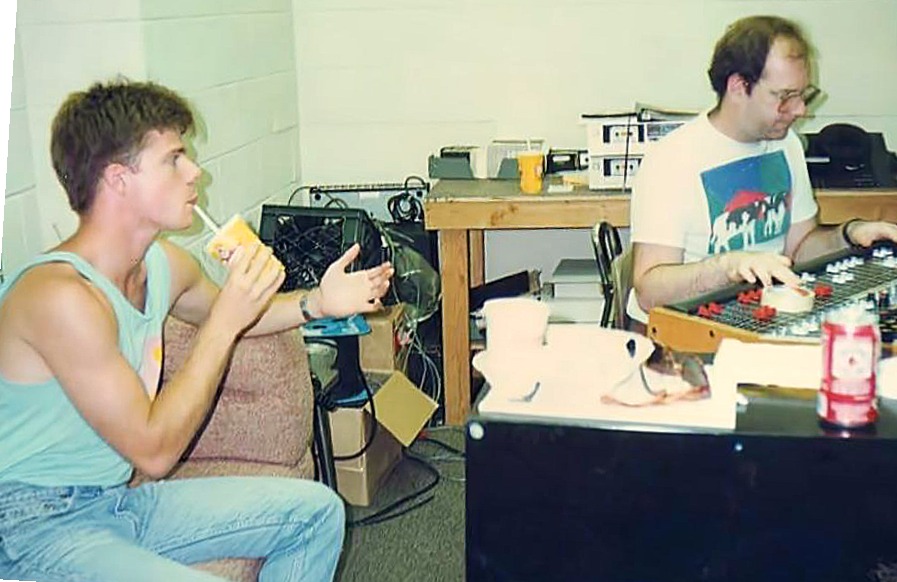
BG (left) and engineer Vann Weller (right) listening to playback - Unite!, August 1989

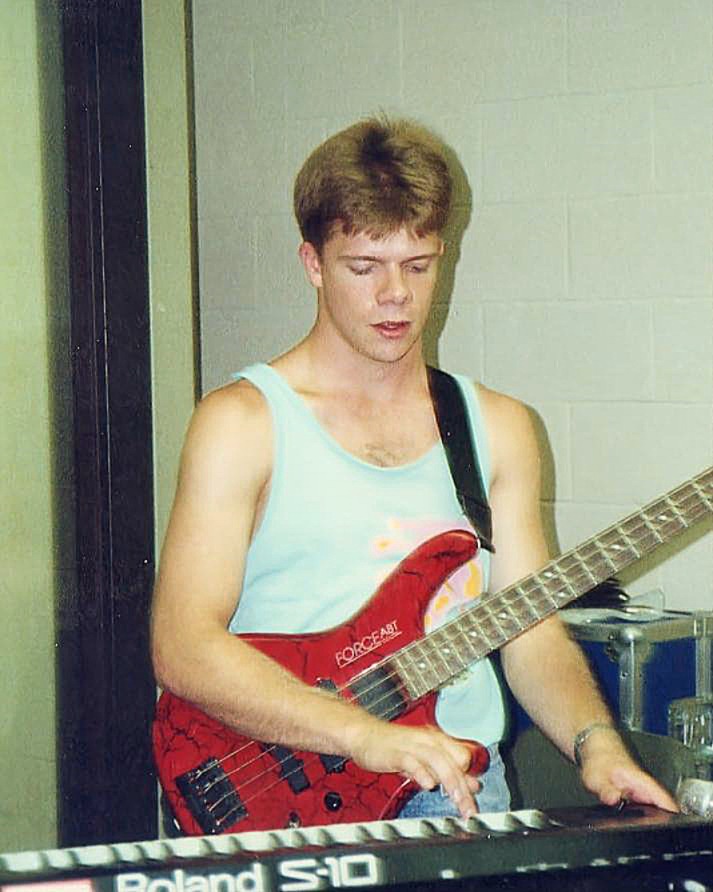
Recording overdubs - Fort Dix Army Post Studio, August 1989
The Pivot Year - 1990
Spring 1990
Berklee College of Music
No rock recordings that year - and for good reason. Brian was at Berklee College of Music on scholarship - one of the world's great music schools - where his jazz identity began to take root. The songs written there were rehearsed but not formally recorded; they would later find their way onto subsequent albums with real players. Berklee was where the pivot happened: from rock instinct to jazz architecture.
Fall 1990
Frostburg State University - Maryland
One semester at Frostburg State in Maryland, where Brian was - by his own account - a big fish in the music program after arriving fresh from Berklee and the Army Band. He got married that semester (his words: too young). And he wrote his first arrangement: a Steely Dan cover of F.M. for the college band. He played lead alto sax and soloed on his own arrangement - a first glimpse of the arranger-composer identity that would define his later work.
1991-1992
The Rock Era Closes
Ten more tracks land between 1991 and 1992, including the Baltimore studio session for Round and Round. The rock era winds down creatively - not with a fade but with a full sprint to the finish. By the time the last track was done, the seeds planted at Berklee were quietly growing. The jazz albums were coming. But not yet.
1992
Re-enlistment - Presidio of San Francisco
Brian reenlisted in the U.S. Army Band and was assigned to the Presidio of San Francisco - the same posting where Song #49 would later be recorded for Explorations. The Presidio years represent the true beginning of his jazz identity, planting the earliest seeds of what would become Explorations and the Hodgepodge Jazz Garage material. The rock era was over. The jazz era was about to begin.
The Complete Track Listing
The Fort Dix Sessions - 1987 to 1989 - Tracks 1-8
The final recording made at the Fort Dix Army Post studio - and the album opener. Unite! is a statement of pure optimism: hopeful, progressive, and rocking hard from the first bar. Brian played every instrument and vocal part himself, with Randy Servello returning one last time on drums for what Brian calls "one final hoorah." Mixed time signatures run through the middle section alongside a "creative grab bag" - sounds and ideas thrown together with total confidence and zero apology.
The song has two verses that tell a complete arc. The first opens with a direct plea: "People of the world unite, aren't you gettin' tired of this fight..." Then comes the long proggy middle - the musical argument. And the second verse lands with the conclusion Brian had apparently already decided: "Now that you are all United, I guess that you are invited - to come here and see just what it's doin' to me - I feel my brain is so enlightened."
The logic: if you're not United, listen to the music - and after that, you'll be enlightened. The optimism of a 21-year-old Army musician on the verge of everything changing, with Berklee College of Music waiting in January 1990. And then, just like that - poof. His 1980s were over.
"Hey, a guy can only hope..."
- Brian Grace, 1989. Fort Dix, NJ.
🎧 Preview Clip - Unite!
Opens at the preview moment in a new tab. Every listen counts toward the album.
02
Fort Dix, NJ
03
Baltimore Studio
04
Fort Dix, NJ
Brian's first fully realized rock composition - and the moment he first felt his rock voice and emerging jazz sensibilities collide in a way that felt honest. The song carries a raw, youthful intensity throughout: open string riffs, soaring lead lines, and a rhythmic pulse that feels like someone trying to break out of their own skin. Melodic guitar writing, emotional storytelling, and the harmonic instincts of a young musician just beginning to discover what he was capable of.
The rebellious streak that would define so much of Brian's creative identity didn't start in a recording studio. It started in a parking lot at Fort Dix, NJ - where he drove around with a bumper sticker that read "Question Authority." A minor act of heresy in the U.S. Army of the late 1980s. That same quiet defiance lives inside this song.
The Inside Looking Out became the audition piece Brian performed to earn a spot in the 1988 U.S. Army Soldier Show - and ultimately the song he played for thousands of troops around the world as a member of the show. For the full story of that chapter, visit the Archives section of this website.
🎧 Preview Clip - The Inside Looking Out
Opens at the preview moment in a new tab. Every listen counts toward the album.
06
Fort Dix, NJ
The origin of this song traces back to 1985 - an 11th grade psychology class that planted a seed Brian could not shake. The concept of habituation - how people fall into repetitive patterns without realizing it, becoming so accustomed to their routine that variation disappears entirely - hit him like a revelation. He was already wired to question everything, already an advocate of thinking for yourself, and the idea gripped him: at what point does this happen to people, and what does it take to break the cycle? Most never do - and that fascinated him enough to turn it into a song.
Four years passed between writing the song's core elements and having the tools to actually record it. When the Fort Dix studio became available, Brian came in fully prepared - and it showed. Complex time signatures, deliberate musical left-turns, and a structure that refused to stay predictable. Well over seven minutes long, Habituation became his first true epic - and the moment he realized: "This is who I am musically." It came together with that rare ease that only arrives when a piece of music has been living in your head long enough to fully form itself. Brian played all instruments except drums, handled deftly by Army Band pal Randy Servello.
Brian's note: "I took myself WAY too seriously back then - but I recorded it and felt that it needed to get done." It did.
🎧 Preview Clip - Habituation
Opens at the preview moment in a new tab. Every listen counts toward the album.
08
Fort Dix, NJ
The 1991-1992 Recordings - Tracks 9-19
Tracks 11-17 are the Tascam 4-track cassette demos - Fall 1991, recorded between Army Band tours. Raw, honest, and overflowing with ideas.

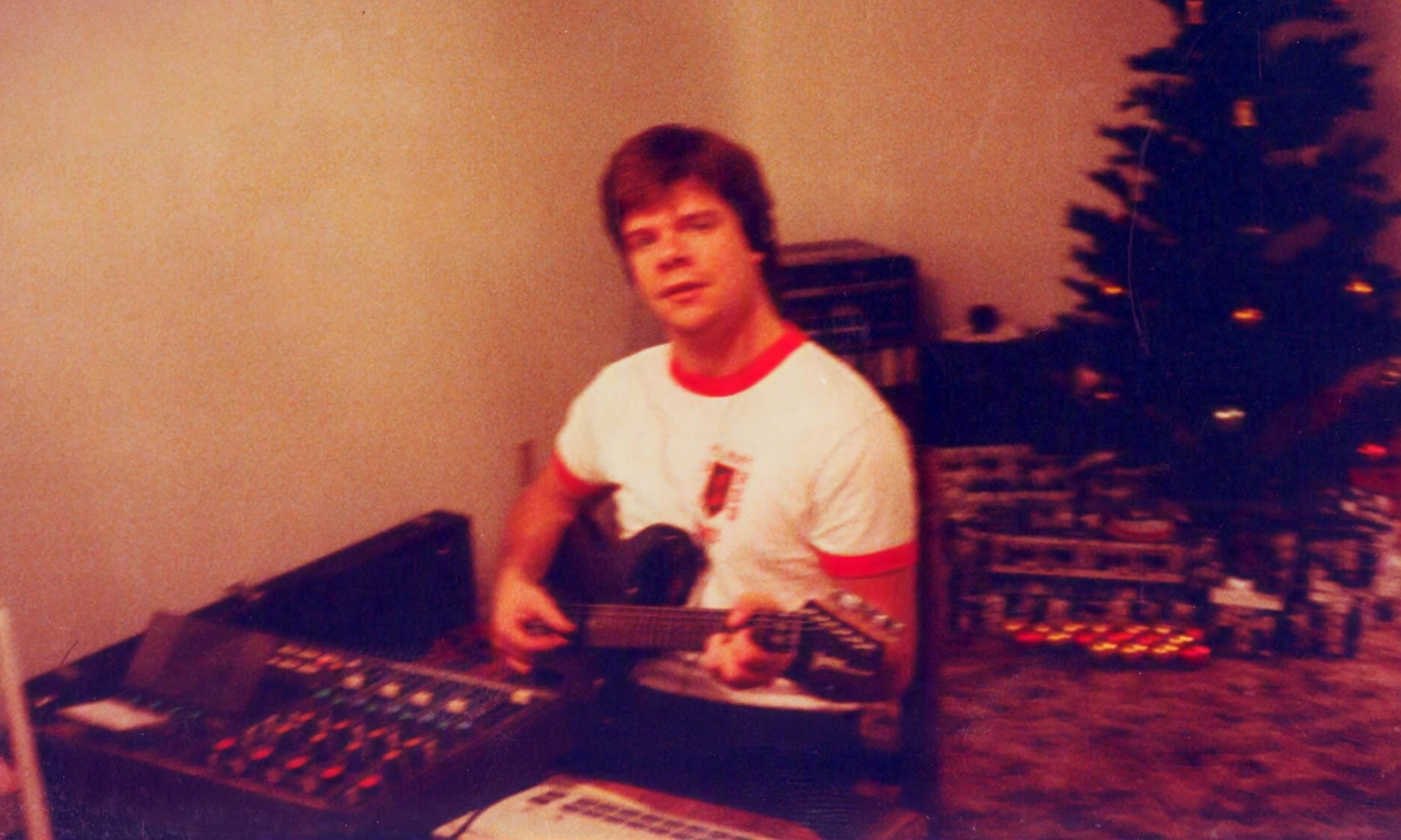
📷 A rare shot - recording 7 songs back to back on the Tascam 488 Portostudio, December 1991. Tracks 11-17 were laid down in this single session.
Seven songs. One session. The Tascam 488 Portostudio cassette recorder humming away, ideas going straight to tape as fast as Brian could write and play them. This is what resourceful recording looked like in 1991 - no studio time to waste, no second chances on the tape, just pure instinct and execution.
Recorded in Baltimore in early 1992, The Magic Candle holds a special place in the catalog: it is 100% performed on a brand-new Korg M1 keyboard that Brian had just purchased. Every sound, every part, every sequence - all programmed in by hand, entirely self-taught. As Brian puts it: it was a MIDI and sequencer training ground - and a song, too. The fact that it works as both at once says everything about how he learned to make music: by doing it for real, with something on the line.
Instrument
Korg M1 Keyboard (all parts)
Method
MIDI Sequencing - Self-Taught
Location
Baltimore, MD - Early 1992
The second song ever recorded on Brian's brand-new Tascam 488 Portostudio cassette recorder - purchased upon arrival at his second Army Band enlistment at the Presidio of San Francisco. The very first was Rise of the Midnight Son, recorded the moment he figured out how to work the machine. These two tracks represent the dawn of the Tascam era - the beginning of a home recording approach that would shape the next phase of his catalog entirely.
Recorder
Tascam 488 Portostudio
Tascam Order
2nd Song Ever Recorded
Location
Presidio of San Francisco, 1992
11
4-Track Demo
12
4-Track Demo
13
4-Track Demo
14
4-Track Demo
15
4-Track Demo
16
4-Track Demo
The last of the seven Tascam 4-track cassette demos - and Brian's shortest song ever at exactly one minute. Don't mistake the length for lack of ambition. Cerebral Psychosis is quirky, proggy, and locked into 7/4 time - a notoriously tricky odd meter to pull off cleanly on any equipment, let alone a cassette-based 4-track recorder from the late '80s. The fact that it holds together is a testament to how far Brian had pushed himself as both a composer and a self-taught engineer in a remarkably short time.
It closes 1991 and the entire series of seven Tascam demos with a bang - 60 seconds of controlled chaos that says everything it needs to say and then stops. No wasted bars, no padding. Pure instinct.
🎧 Preview Clip - Cerebral Psychosis
Opens at the preview moment in a new tab. Every listen counts toward the album.
Brian's own assessment, delivered without flinching: "It sounds like a bad Kansas cover band that tried to write an original song, but it ended up like this." Written during his Christian years, damn near Christian rock by his own description - tired, naive, and never quite coming together the way he wanted. It is included here strictly for archival and jovial necessity. Not every song in a catalog has to be a highlight. Sometimes the most honest thing you can do is leave the evidence in and let it speak for itself.

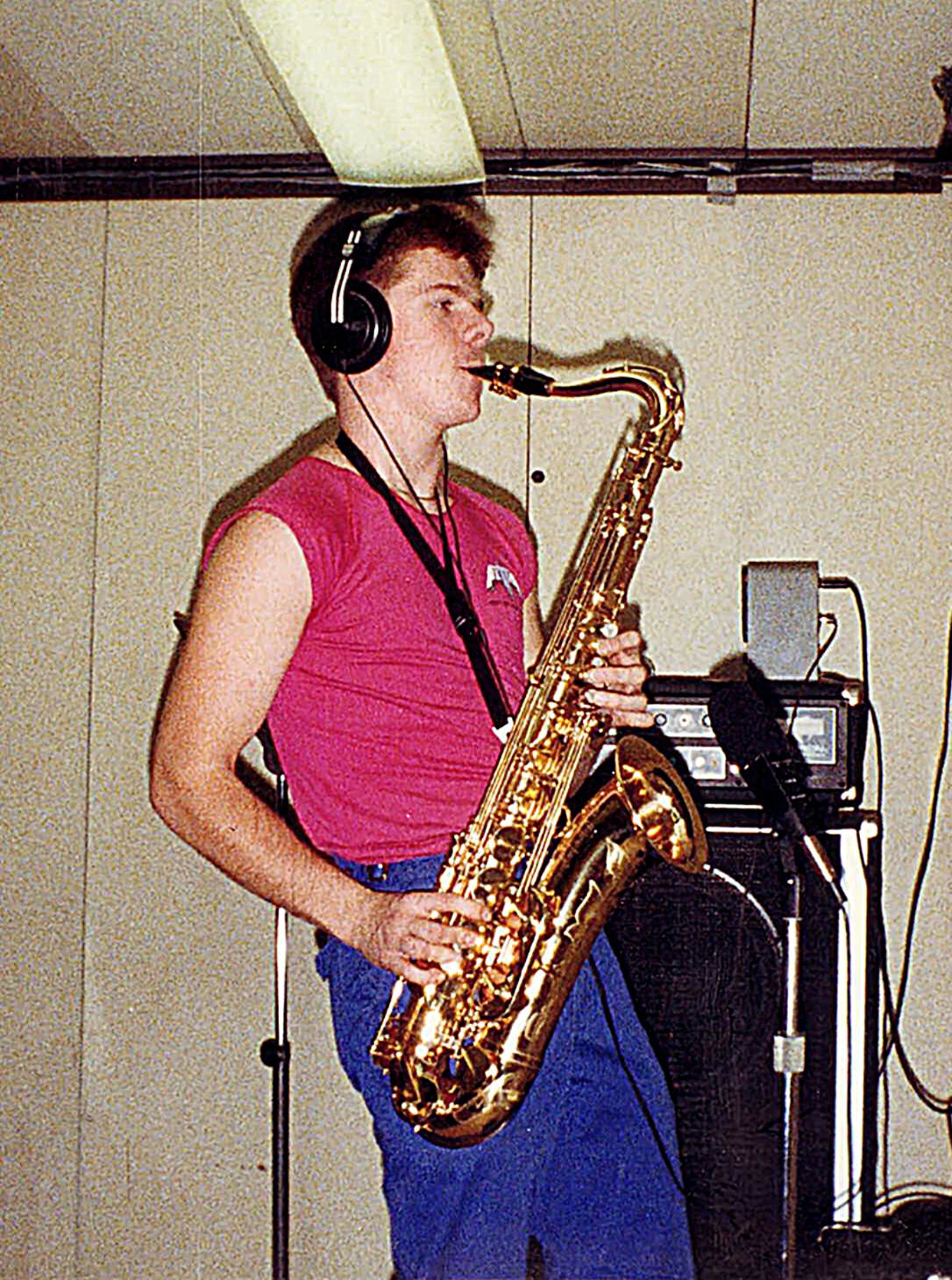
📷 A rare shot - recording the sax solo on "Wait and See" at Fort Dix studio, January 1988 - before shipping out with the Army Soldier Show.
Two ballads - patched together, perhaps to put the love song chapter away for good. The first, The Right Time for Love, is solo piano and voice: tender, drifting, love-stricken. Then comes All My Life, which starts as more of the same before doing something completely unexpected: a slow build across two full minutes, adding instrumentation layer by layer until it erupts into what Brian calls "a downright party" - hand-clapping, intersecting vocal lines, multiple simultaneous choruses colliding into something close to a pentecostal revival.
And buried inside that euphoric outro? Brian sings out the titles of every Fort Dix song he had recorded up to that point - The End of Summer, The Inside Looking Out, Korean Morning, Funkistice, Palm of Your Hand - in a hopeful lead vocal, like a catalog toast to everything he had built. Then, almost as a whisper into the future, he foreshadows one more title: Unite! - a song he is currently writing but has not yet recorded. A clue hidden in plain sight for anyone paying attention.
The second-to-last recording made at the Fort Dix Army Post studio. Unite! would be the last.
Structure
Two Songs Combined
Part 1
Solo Piano and Voice
Part 2
Full Build - Vocal Chorus Explosion
Hidden Detail
Every Fort Dix title sung in the outro
Finally Released - 2008
When these recordings were finally released in 2009, they arrived after Weapons of Jazz Construction - which makes the timeline a little upside down. The earliest music in Brian's catalog came out after some of the later jazz work. But in a sense, that makes it more meaningful: this was not a quick cash-in on archival tapes. It was a considered decision to finally put the origin story in front of the audience that had been following the jazz albums.
The release on Bandcamp - and the planned expansion to TuneCore - gives these tracks the platform they always deserved. Remastered, sequenced, and presented with full context, The Early Rock Daze is no longer just a collection of old tapes. It is the prequel that finally explains everything that came after.
19
Tracks
5
Years of Recording
2026
Remaster
2009
Original Release
🎬 See It Live
Oh, Lisa & Don't Give Me Your Religion
Live performances from Mill Valley, CA - 1995. Both tracks from this album captured on video - raw and real.